Rengejo-in Temple, Koyasan: the Sanada family temple, rooms and how to book
Rengejo-in is a Koyasan Shingon temple and temple lodging (shukubo) at 700 Koyasan, known as Sanadabo: the Sanada family temple on the mountain. You can stay in rooms from a standard fusuma-divided room to a garden suite, eat a plant-based dinner served by the monks and join their meditation.
By Alex · Updated 12 Nov 2026

Key points
- Rengejo-in is the Sanada family’s temple on Koyasan. After the Battle of Sekigahara, Sanada Masayuki and his son Nobushige spent part of their confinement here.
- Rooms start at ¥19,000 per person, and suites at ¥42,000. The standard room is divided from its neighbor by fusuma and shares the bath; the suites, 60 to 70 square meters, have their own bath and toilet.
- A night includes meditation, dinner and 6 am prayers. Guests are invited to the monks’ breathing meditation, and the monks serve plant-based shojin ryori.
- The temple stands in the northwest of Koyasan. The bus no longer runs past it: get off at Kongobuji-mae or Senjuin-bashi and walk about 15 minutes. Ichi-no-hashi, where the path through Okunoin starts, is about 1,360 m away in a straight line.
- The temple takes bookings on its own new website. Plans there are paid in advance. Booking.com, Trip.com, Agoda and Rakuten Travel list it too.
What kind of temple is Rengejo-in, and how old is it?
Rengejo-in (蓮華定院) is a temple of the Koyasan Shingon sect and a shukubo, founded in the Kenkyu era (1190–1199) of the early Kamakura period. Its principal image is Amida Nyorai.
The priest Gyosho Shonin (1130–1217), who had trained in the Sho-no-Iwaya cave in Yoshino, founded Isshin-in Temple in the valley where Rengejo-in stands. One of Isshin-in’s subsidiary temples, Okunobo, also had Amida Nyorai as its principal image, and it later became Rengejo-in.
If you are still choosing, compare all 36 temples.
Rengejo-in and the Sanada family
Rengejo-in is the Sanada family temple on Koyasan. After the Battle of Sekigahara (September 1600), Sanada Masayuki and his second son Nobushige (Yukimura) were confined to Koyasan and lived for a time at Rengejo-in, which had been the family’s shukubo for generations.
Women could not enter Koyasan, so the temple prepared a residence for the two men in Kudoyama, at the foot of the mountain. There, their wives and children could live with them.
Nobushige lived at Rengejo-in and Kudoyama for 14 years in all and took the priestly name Kohaku. In November 1614 he left Kudoyama to fight for the Toyotomi at Osaka, and he was killed in the Summer Campaign that followed.
In his lifetime he went by Nobushige. The name Yukimura first appears in a military chronicle published after his death.

What to see: the main hall, gardens and treasures
The grounds hold a main hall, a dry rock garden, a courtyard pine and maple and a lord’s audience room, and the treasures include Sanada letters. That audience room, the Jodan no Ma, has a raised floor and was rebuilt in 1860 in the same place, size and style as the one where Sanada Masayuki sat.
Main hall, gate and gardens
The present main hall, kitchen and main gate were rebuilt in 1860 with Sanada support, and the temple survived a major fire in 1888. The main hall is a roppozo, with thick earthen walls on all six sides. It holds the hidden principal image, Amida Nyorai, and a mortuary tablet that Sanada Masayuki made for himself.
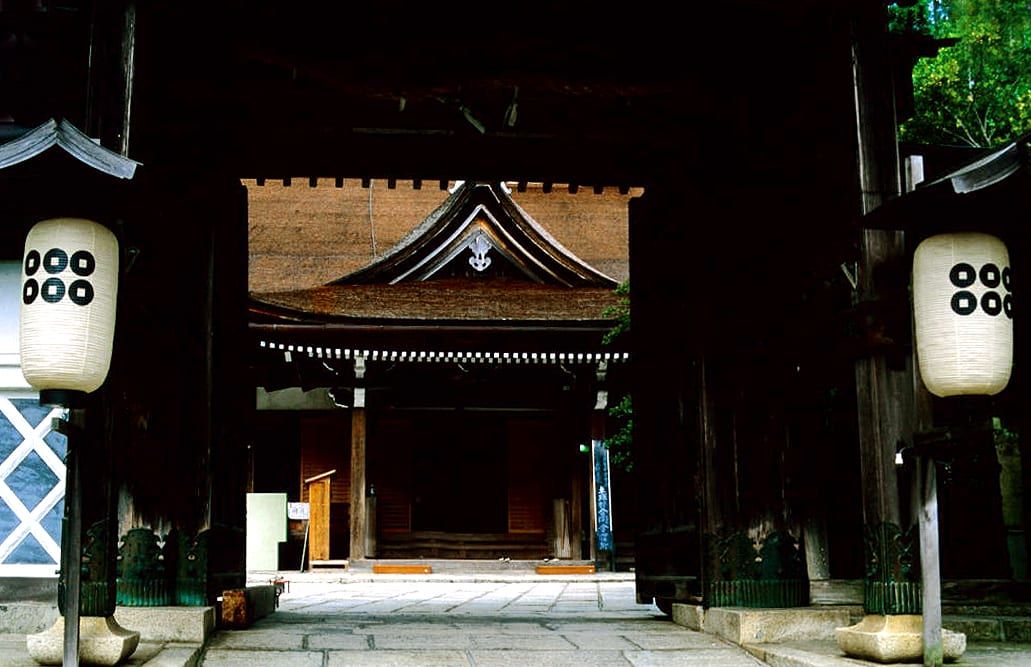
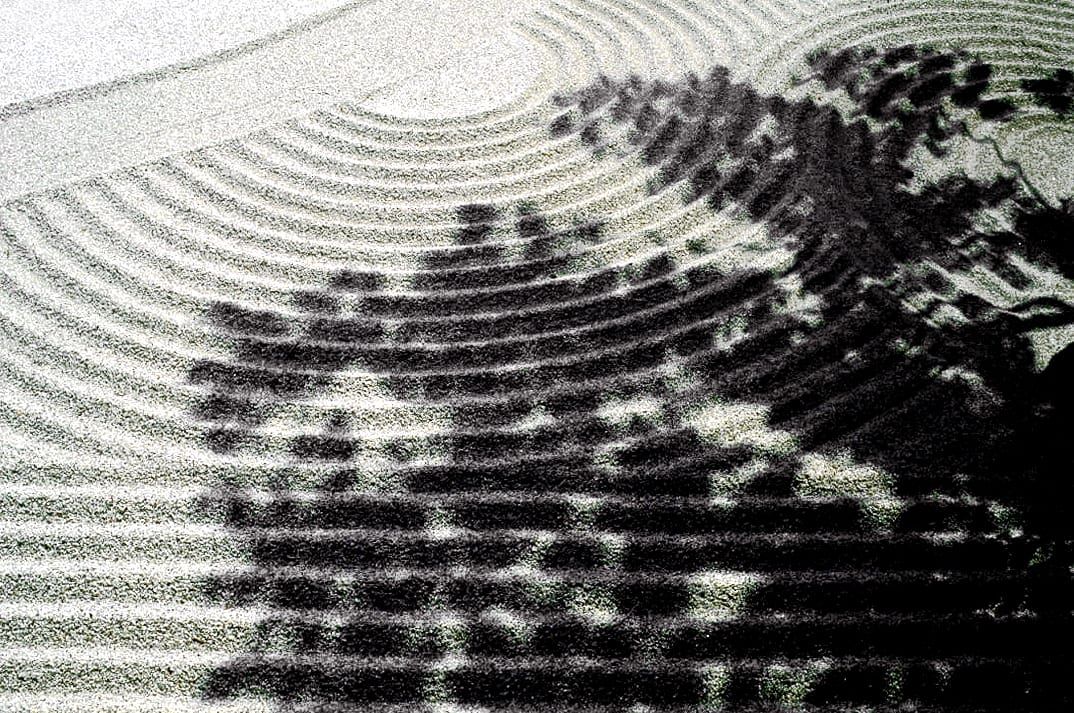
Large paper lanterns with the Sanada Rokumonsen crest hang on the main gate. The front garden is a dry rock garden (karesansui) whose raked sand shows the Sanskrit character hrih, pointing to the hidden Amida in the main hall. In the courtyard stand a pine tree over 500 years old and a maple that survived a fire in the Tempo period.
Tombstones and treasures
Behind the temple stand tombstones of the Sanada family, including Nobuyuki and his son Nobumasa. The treasures include letters in Nobushige’s own hand: in one he begs off a festival with a stomachache, and in another he asks for a pot of shochu. The sources this guide used do not say which rooms or treasures guests can see.
Rooms and baths
Rengejo-in has renovated rooms and now sells more room types than its older pages describe, plus shared bathrooms with shampoo, conditioner, body soap and a hair dryer.
Room types
The temple’s new booking site (checked on November 12, 2026) lists these rooms, all non-smoking, with dinner and breakfast:
| Room | Size and bathroom | From, per person (2 in a room) |
|---|---|---|
| Standard room | fusuma-divided Japanese room, shared bath and toilet | ¥19,000 |
| Superior room | 40 m², garden side, own toilet | ¥23,000 |
| Deluxe room | 42 m², garden side, own shower and toilet | ¥33,000–37,000 |
| Suite | 60–65 m², garden side, own bath and toilet, two beds | ¥42,000 |
| Premium suite | 70 m², garden side, own bath and toilet, two beds | ¥77,000 |
These are the cheapest plans for each room; other plans cost more (the premium suite up to ¥96,000 per person). Prices change by date. The older association pages describe the suite (kihin-shitsu) as about 33 square meters, the superior room (tokubetsu-shitsu) as about 29 and the standard room as about 15; the new site does not use those names.
The suites suit you if you want your own bathroom. The standard room suits you if sliding doors to the next room do not bother you.
The large shared bath, which uses spring water from the mountain, is open from 6:30 pm to 9:30 pm, and sometimes earlier depending on the season.
Facilities and capacity
Rooms have towels, bath towels, yukata and a safe, and Wi-Fi is free. Smoking is not allowed in the building, but there is a smoking area. There are vending machines but no shop stalls.
The temple has 7 rooms with walls and 41 divided by fusuma, plus a large hall, for about 120 individual guests or 150 in groups. Groups are welcome. No official source this guide used mentions a natural hot spring (onsen) at Rengejo-in.
A night at Rengejo-in: meditation, dinner and morning prayers
A night here includes meditation with the monks, a 6 pm dinner, a 9 pm curfew, morning prayers at 6 am and breakfast at 7 am.
Meditation and the evening
At meditation, the monks practice ajikan and asokukan breathing and invite guests to join. The temple’s site puts it at 5 pm, while the Koyasan Shukubo Association’s page lists it from 5:30 pm. The association’s page also lists a fire ceremony (goma) at night, almost every day, and lists the morning service as free.
Dinner and breakfast
Dinner is shojin ryori, plant-based temple food, served by the monks in a large hall divided by fusuma screens. Breakfast is made with shiitake mushrooms, seaweed and dried vegetables.
Morning prayers and sutra copying
At the morning prayers, the monks read sutras for the departed and for family peace, and names of the departed can be read out if you ask the day before. Sutra copying can be done at a time of your choice; it costs ¥1,500 on the temple’s site and ¥1,000 on the association’s page.
Where Rengejo-in is and how to get there
Rengejo-in stands at 700 Koyasan, in the northwestern part of Isshin-in Valley, one of the ten valleys of Koyasan (Koya Juttani), in the northwest of the mountain. Measured in a straight line on OpenStreetMap, it is about 1,360 m from Ichi-no-hashi, the first bridge and the start of the path through Okunoin. That is not a walking distance, and the sources give no walking time.
By bus or car
The bus no longer serves the streets around the temple: Nankai Rinkan Bus stopped that route on August 26, 2024, the temple’s booking site says. From Koyasan Station, take the bus to the Kongobuji-mae or the Senjuin-bashi stop and walk about 15 minutes. The temple has no pick-up service, and if you drive, there is parking for 8 cars in front of the gate. For the journey to the mountain itself, see how to get to Koyasan.
On foot
On foot, you can reach the temple from the Kyo-Osaka-michi, one of the seven pilgrimage routes up Koyasan. Take the Fudozaka trail to Fudozaka-guchi, then walk down the Nyonindo slope. In the Edo period, this was the shortest route from Kyoto and Osaka.
Nearby Nyonindo is the only women’s hall left on Koyasan. The mountain road from Irohazaka (formerly Fudozaka) to Nyonindo became part of the World Heritage site in October 2016. For more trails, see hiking at Koyasan.
Booking, payment and cancellation
You can book Rengejo-in on its own new reservation website, and it is also listed on Booking.com, Trip.com, Agoda and Rakuten Travel. The temple also has a page in the Koyasan Shukubo Association’s reservation system, but no plans were listed there on October 21, 2026.
Prices
On the temple’s own booking site, a night with dinner and breakfast costs from ¥19,000 per person in a standard room and from ¥77,000 in the premium suite, with two in a room (see the table under Room types).
Payment and cancellation
Payment is by VISA or Mastercard, and the plans on the temple’s booking site are paid in advance. If you will arrive late, call before 6 pm: for late arrivals, the temple says the gate may already be closed after 7 pm, so check-in may not be possible, and a guest who has not called by 6 pm is treated as cancelled after 9 pm. The cancellation fees are:
- 9–14 days before: 10%
- 6–8 days before: 20%
- 2–5 days before: 30%
- One day before: 50%
- On the day: 100%
If Rengejo-in does not suit your dates or needs, compare all 36 temples.
Is Rengejo-in a good fit for you?
Rengejo-in suits you if you want Sanada history or plant-based food; young children, gluten-free diets and wheelchairs need more planning.
| Your situation | Good fit? | Why |
|---|---|---|
| You came for Sanada history | Yes | Sanada family temple, with Sanada crests, letters and tombstones |
| You eat vegetarian or vegan | Yes | Plant-based shojin ryori; the temple can cater for vegan diets |
| You need gluten-free food | Book without meals | Shojin ryori is hard to make gluten-free |
| You travel with young children | Yes, check the room | Some walls are thin paper; children 6 and under can’t join ceremonies |
| You use a wheelchair | Limited; ask first | Wheelchairs generally not allowed inside; temple may help on first floor |
How this guide was researched
This guide draws on Rengejo-in’s official website, three sites of the Koyasan Shukubo Association (English, Japanese and reservations), four booking partners’ listings and OpenStreetMap. In all, 12 sources were read. Where the temple and the association give different values, both are shown.
FAQ
What time is check-in and check-out at Rengejo-in?
Check-in is from 3 pm. Check-out is at 10 am on the temple’s site and at 9 am on the Koyasan Shukubo Association’s page. The temple holds luggage before check-in and after check-out.
Can children stay at Rengejo-in?
Yes, young children can stay. Some rooms have thin paper walls, so the temple asks parents to check which room suits them. Preschool children (6 and under) cannot take part in the ceremonies.
Is the food at Rengejo-in vegan?
Yes, it can be: the temple can cater for vegan diets. Its shojin ryori is plant-based and suitable for vegetarians.
What if you need gluten-free food at Rengejo-in?
Book a stay without meals, as the temple suggests; it says shojin ryori is hard to make gluten-free. For food allergies, tell the temple before your visit.
Why is Rengejo-in called Sanadabo?
It has been called Sanadabo, the Sanada family temple on Koyasan, since it renewed its shukubo agreement with Nobuyuki, Nobushige’s older brother. It may also use the Sanada crests Rokumonsen and Karigane as its own.
Can you bring a wheelchair inside Rengejo-in?
No, not as a rule: wheelchairs are generally not allowed inside. The temple may help on the first floor if you ask.
Sources
- Rengejo-in official website (rengejoin.jp)
- Koyasan Shukubo Association (eng-shukubo.net)
- Koyasan Shukubo Association, Japanese site (shukubo.net)
- Koyasan Shukubo Association reservation site (koyasan-shukubo.net)
- Booking.com
- Trip.com
- Agoda
- Rakuten Travel
- OpenStreetMap