Koyasan day trip or overnight stay: which is right for you?
A Koyasan day trip from Osaka is possible: Limited Express trains reach Koyasan Station from Osaka Namba in 1 hr 40 min, and Express trains in around 2 hours. Staying the night adds the early morning service at a temple, which overnight guests may take part in or watch.
Pick a day trip if you mainly want the sights. Pick a night if the morning service or dinner and breakfast at a temple matter more to you. For Okunoin after dark, check the last trains back first.
By Alex · Updated 19 Nov 2026

Key points
- A day trip from Osaka is possible. The Limited Express needs 1 hr 40 min from Osaka Namba but runs only twice on weekdays; Express trains leave roughly every 20 to 30 minutes and take around 2 hours.
- A night lets you see the morning service. Early each morning, the chief priest and monks chant sutras in the main hall, and guests who stay over may join in or watch.
- General prices include dinner and breakfast. A Japanese-style room with a shared bath and toilet runs ¥15,000–25,000 per adult, and a room with its own toilet, or its own bath and toilet, ¥20,000–70,000.
- Check-in begins in the afternoon. Among the 26 bookable temples that list a check-in time, 21 let you in from 3 pm and the other 5 from 2 pm.
- GetYourGuide sells a day tour and a private walk. The small-group day tour from Osaka starts at about $75 per person; the private guided walk through Okunoin, at dawn and after dark, starts at about $108.
Can you do Koyasan as a day trip?
Yes, you can see Koyasan on a day trip from Osaka. Nankai Electric Railway’s Limited Express Koya leaves Osaka Namba at 10:00 and 13:30 on weekdays, and up to six times on weekends and holidays from March to November. Express and Rapid Express trains leave roughly every 20 to 30 minutes, usually with a change at Hashimoto.
The Limited Express takes 1 hr 40 min from Osaka Namba to Koyasan Station, and the Express around 2 hours. For the full timetable and route, see the train, cable car and bus from Osaka.
For the way back, Nankai’s timetable gives the last connection to Namba at 20:45 from Koyasan Station on weekdays (20:44 on weekends and holidays), with a change at Hashimoto, arriving at 22:26. Check the timetable the week you travel, because it changes with the seasons.
If you would rather go with a group, GetYourGuide sells a small-group day tour from Osaka, from US$74.67 (about $75) per person. Other Koyasan day tours from Osaka, including one with a shojin ryori lunch and one with a private guide who travels with you by train, are on the Koyasan tours page. A day trip suits you if Osaka is your base and the sights are your goal.
What you can see in one day
In one day you can pick from sights such as Okunoin, Danjo Garan, Kongobuji, the Reihokan Museum and the Daimon. No source this guide used says how many hours a visitor needs to see Koyasan, so this guide cannot tell you how many of them fit into one visit.
Okunoin
Okunoin is a vast cemetery in a forest of massive cedars, with the mausoleum of Kobo Daishi at its end. Kobo Daishi, also called Kukai, founded Koyasan in 816.
Measured on OpenStreetMap in straight lines between points, it is about 1.6 km from Ichi-no-hashi to Torodo. The path itself is longer: the Koya Tourism Association puts the approach from Ichi-no-hashi to Kobo Daishi’s mausoleum at about 2 km. How long the walk takes is not stated.
Danjo Garan and Kongobuji
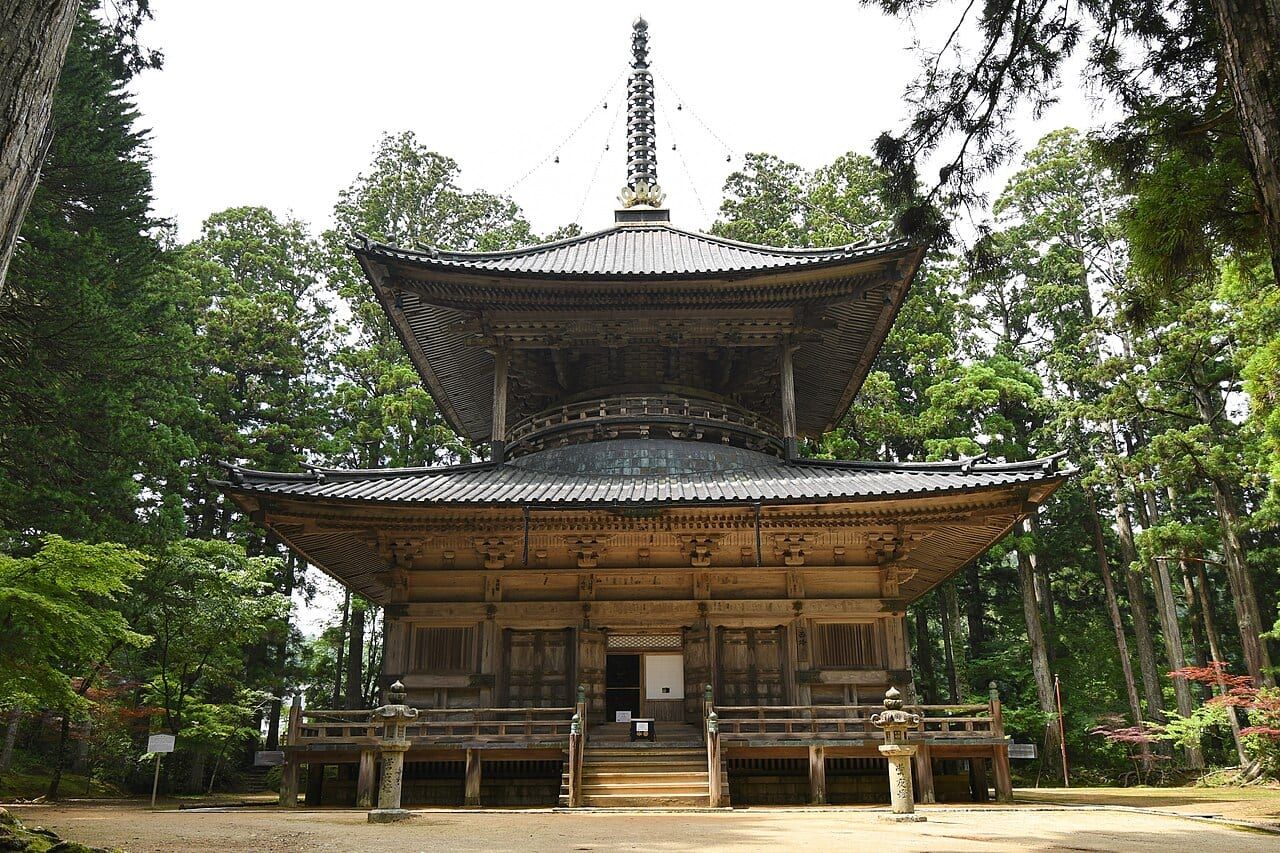
Danjo Garan is one of the most important places in Koyasan. It is a set of religious precincts with many religious and historical monuments, among them the Konpon Daito, a towering pagoda Kobo Daishi built as a symbol of Shingon Buddhism.
Kongobuji is the head temple of the Shingon sect, which has 4,000 temples across Japan and more than 10 million followers worldwide. Visitors can see religious artifacts, shoji screen paintings and a rock garden of two dragons in the clouds.
The Reihokan Museum and the Daimon
The Reihokan Museum shows a collection of religious art, many pieces of which are Japanese national treasures. The Daimon, guarded by two fierce-looking statues, is the main gate to the town.
The Koya Tourism Association gives admission to the Reihokan as 1,300 yen, with student discounts; the museum closes over the New Year and sometimes between exhibitions. Kongobu-ji’s official fee list gives ¥1,000 for Kongobu-ji and ¥500 each for the Kondo and the Konpon Daito in the Danjo Garan, open 8:30 am to 5 pm; see the Kongobu-ji guide for the full table. Check the Reihokan’s hours before you build your day around it.

What an overnight stay gives you
An overnight stay gives you the early morning service. At shukubo temples, the chief priest and monks chant sutras in the main hall early every morning, and overnight guests may take part or watch. To compare temples, see temple stays in Koyasan.
Meditation and fire rituals
Some temples add their own rituals. Of the 36 temples partners sell, 17 list meditation and 10 a goma fire ritual, counted from each temple’s page on the temple association’s sites. At Eko-in, the goma fire ritual is performed every day at 7:30 am, after the morning service.
Only a few shukubo temples can offer ajikan meditation to private visitors. Some of these rituals are also open to visitors who are not staying, as the FAQ below explains.
Okunoin at dawn and after dark
A night also puts you in Koyasan after dark and at dawn. GetYourGuide sells a private guided walk called “Koyasan: Sacred Silence of Okunoin at Dawn and After Dark” from US$107.57 (about $108) per person.
Eko-in’s site says the Okunoin night tour, run by another company with Eko-in as the meeting place, often gets fully booked from March to November. If your night falls in those months, book it early. A night suits you if the service, the rituals or Okunoin after dark are the point of your trip.
What a night in a temple costs
A temple night with dinner and breakfast costs ¥15,000–25,000 per adult in a Japanese-style room with a shared bath and toilet, going by the general prices on the temple association’s reservation site. A room with a private toilet, or with its own bath and toilet, is ¥20,000–70,000 per adult on the same terms.
Only 5 of the 36 bookable temples have a price in the association’s reservation system. Their “from” prices per adult and night include tax and half board. They are ¥14,000 at Fugen-in, ¥14,300 at Hojo-in, ¥17,000 at Fudo-in, ¥19,800 at Daien-in and ¥21,000 at Eko-in.
If you travel alone, note who these rooms are for. Every room in the plans of Eko-in, Fudo-in, Fugen-in and Hojo-in is for at least 2 guests, so their “from” prices assume two or more people in a room; Daien-in also lists rooms that 1 guest can book.
If cost decides it, a day trip leaves out the room entirely. If you stay, the shared-bath rooms have the lower of the two general price ranges, and both include dinner and breakfast.
A one-day plan and a two-day plan
A one-day plan fits the sights between the train up and the train back, while a two-day plan adds a temple night and the morning service. If that service is your reason for going, the two-day plan is the one built around it.
For either plan, look at the World Heritage Ticket: its train ticket and bus pass are valid for 2 consecutive days. From Namba it costs ¥4,210 for adults, or ¥5,200 with a Limited Express Koya ticket for the outbound trip.
The one-day plan
- Ride the Limited Express or an Express from Osaka Namba to Koyasan Station.
- Start with the sight you would least like to miss, then add others as time allows.
- For a temple lunch, book ahead at Eko-in, Shojoshin-in or Komyo-in; the FAQ below gives the prices.
The two-day plan
- Day one: arrive, see the sights, then check in. Of the 26 bookable temples that list a check-in time, 21 start check-in at 3 pm and 5 at 2 pm.
- Afternoon and evening: at Eko-in, for example, ajikan meditation is at 4:30 pm and dinner at 5:30 pm.
- Day two: take part in or watch the morning service, and the goma fire ritual if your temple holds one.
- Eko-in’s check-out, for example, is at 10 am, which leaves the rest of day two for sights and the train back.
When to go
Go from the end of April to early May, when the cherry blossoms are at their best, or in October, when fall foliage colors the mountain. Cherry blossoms on the mountain come about a month later than at its foot.
In summer it is about 10 degrees cooler than the valley below. Schools visit in late July and August, and this is the peak tourist season, so plan around those weeks if you would rather avoid school groups.
The first frosts fall by early November, the first snow may come in mid-December, and snow usually stays until February. For more on each season, see best time to visit Koyasan.
Day trip or overnight: which fits you?
Stay overnight if the morning service or dinner and breakfast at a temple matter to you; if you mainly want the sights, a day trip from Osaka fits.
| Your situation | Day trip or overnight | Why |
|---|---|---|
| Osaka is your base and you want the sights | Day trip | Limited Express: 1 hr 40 min from Osaka Namba |
| You want a group tour from Osaka | Day trip | GetYourGuide sells a small-group day tour from about $75 |
| You want a temple lunch, not a room | Day trip | Eko-in, Shojoshin-in and Komyo-in serve lunch to non-guests, by reservation |
| You want the morning service | Overnight | Overnight guests may take part or watch |
| You want Okunoin at dawn or after dark | Check the last trains first | GetYourGuide’s walk is at dawn and after dark; last train times are not given |
| You want dinner and breakfast at a temple | Overnight | General prices are half board: ¥15,000–25,000 with shared bath |
How this guide was researched
This guide is built from the Koyasan Shukubo Association’s English site and reservation system, the Koya Tourism Association, the official websites of Eko-in, Shojoshin-in, Komyo-in and Fukuchi-in, Nankai Electric Railway, OpenStreetMap and GetYourGuide’s listings. In all, 16 sources were read. Temple counts and straight-line distances were worked out from that data.
FAQ
Is a temple stay at Koyasan worth it?
Yes, if you want the morning service or dinner and breakfast at a temple: overnight guests may take part in the service, and the temple association’s general prices are half board. If the sights are all you came for, a day trip saves you the cost of the room. You can compare temples on temple stays in Koyasan.
What time does the morning service start?
Depending on the temple, it may start at around 6:00 am. Of the 36 temples partners sell, 22 give a morning service time, and the earliest listed summer start is 5:50 am, at Daien-in.
Can day visitors eat shojin ryori?
Yes, at Eko-in. It serves shojin ryori lunch to visitors who are not staying, by reservation, from 11 am to 1 pm, and the reservable menus start at ¥5,800. Shojoshin-in and Komyo-in also serve lunch to visitors who are not staying, by reservation: Shojoshin-in two courses for ¥3,750 or three for ¥5,400, Komyo-in 3,850 or 5,500 yen, basically only on Sundays. Fukuchi-in has day lunch plans but has suspended lunch bookings.
Can day visitors join meditation or a goma ritual?
Yes, at Eko-in. Visitors who are not staying can join ajikan for an offering of 2,000 yen, and can apply in advance to join the goma fire ritual.
Do temples in Koyasan have a curfew?
Yes, many do. Of the 36 bookable temples, 21 list a curfew time, most often 9 pm (11 temples), while Eko-in says it has no curfew. If a curfew would cut your evening short, check your temple’s time before you book.
Can you leave your luggage at the temple?
Yes, at Eko-in, which can store your luggage before and after check-in. This guide has no luggage details for other temples, so ask yours when you book.
Sources
- Koyasan Shukubo Association (eng-shukubo.net)
- Koyasan Shukubo Association reservation site (koyasan-shukubo.net)
- Koya Tourism Association (koya.org)
- Eko-in official website (ekoin.jp)
- Shojoshin-in official website (shojoshinin.jp)
- Komyo-in official website (komyouin.jp)
- Fukuchi-in official website (fukuchiin.com)
- Nankai Electric Railway (nankai.co.jp)
- GetYourGuide
- OpenStreetMap