Japanese cemeteries and graves, explained at Okunoin
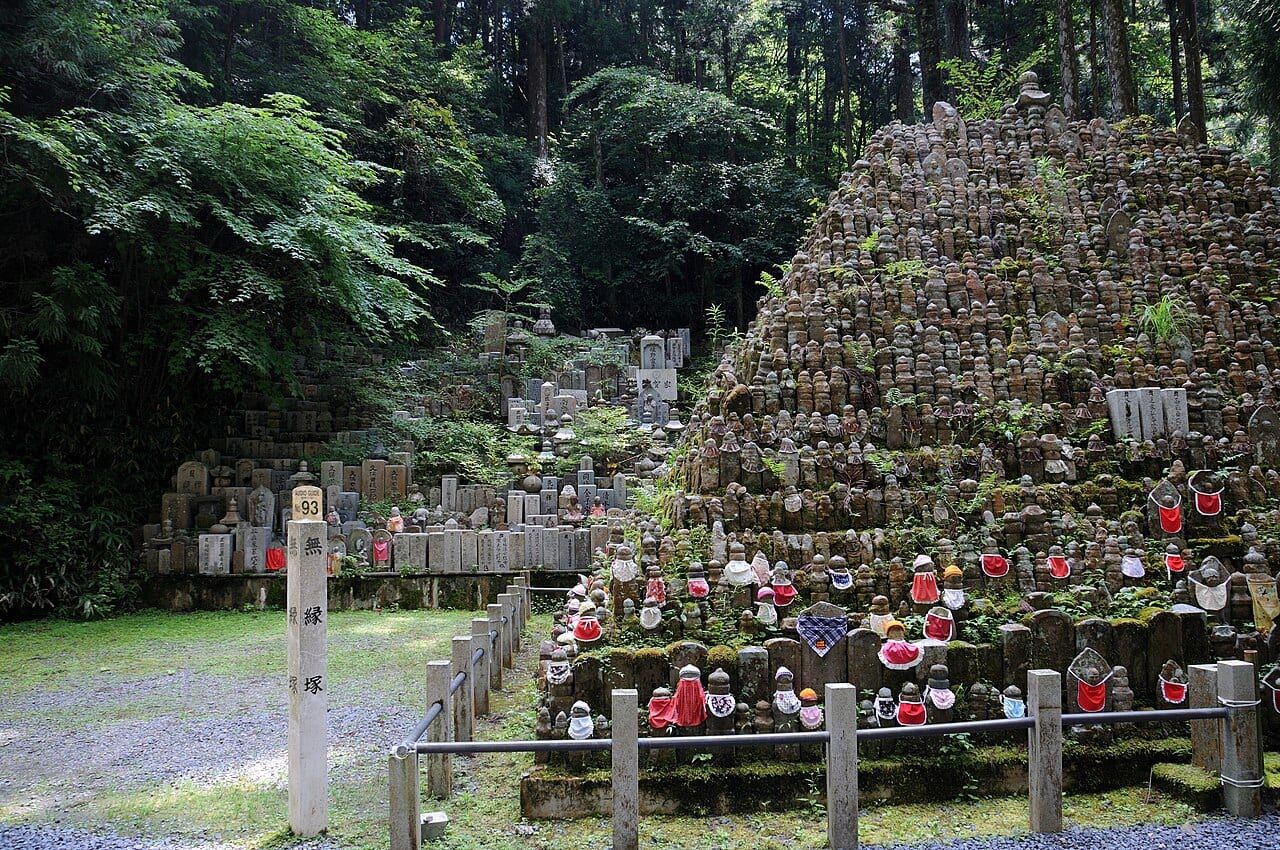
Okunoin is a Japanese cemetery on Koyasan, where an approach of about 2 km is said to be lined with more than 200,000 moss-covered memorial towers and graves. Many of its grave markers are gorinto, towers of five stacked stones.
Warlords, founders of other Buddhist schools and ordinary people rest or are remembered there. One stretch even holds gravestones built by companies.
By Alex · Updated 19 Nov 2026

Key points
- Okunoin is a graveyard laid along one long approach. The path runs about 2 km to Kobo Daishi’s mausoleum, and more than 200,000 graves and memorial towers are said to stand beside it.
- Many markers are gorinto. These five-stone towers stand for sky, wind, fire, water and earth, and building them for the dead is said to have started at Koyasan.
- Status and sect do not divide the people remembered here. The imperial family, warlords and ordinary people lie or are remembered next to each other.
- Companies put up graves too. A stretch of about 200 m holds stones shaped like products and logos, made for late employees; Matsushita Electric’s, from 1938, is the oldest by a company.
- Rituals here use water and light. People pour water at the Mizumuke Jizo before the mausoleum, and on August 13 candles line both sides of the approach.
What makes Okunoin different from other cemeteries?
Okunoin puts people of every rank and sect side by side: they rest or are remembered along the same approach. It is even called the family temple (bodaisho) of all Japanese.
The approach starts at Ichi-no-hashi and ends at the mausoleum of Kukai (Kobo Daishi), under cedars said to be a thousand years old. Kukai entered eternal meditation at Okunoin, and the memorials along the approach were built by people devoted to him.
The sources behind this page do not describe Japanese grave customs in general, such as cremation, family graves or how graves are visited elsewhere in Japan. So this page makes no wider comparison and sticks to Okunoin. For the walk itself, see the Okunoin guide.
Gorinto: the five-part stone towers
A gorinto is a tower of five stacked stones standing for the five elements. Each stone is carved with a Sanskrit letter. From top to bottom, the stones are:
- sky, a jewel shape
- wind, a half-moon
- fire, a triangle
- water, a circle
- earth, a square
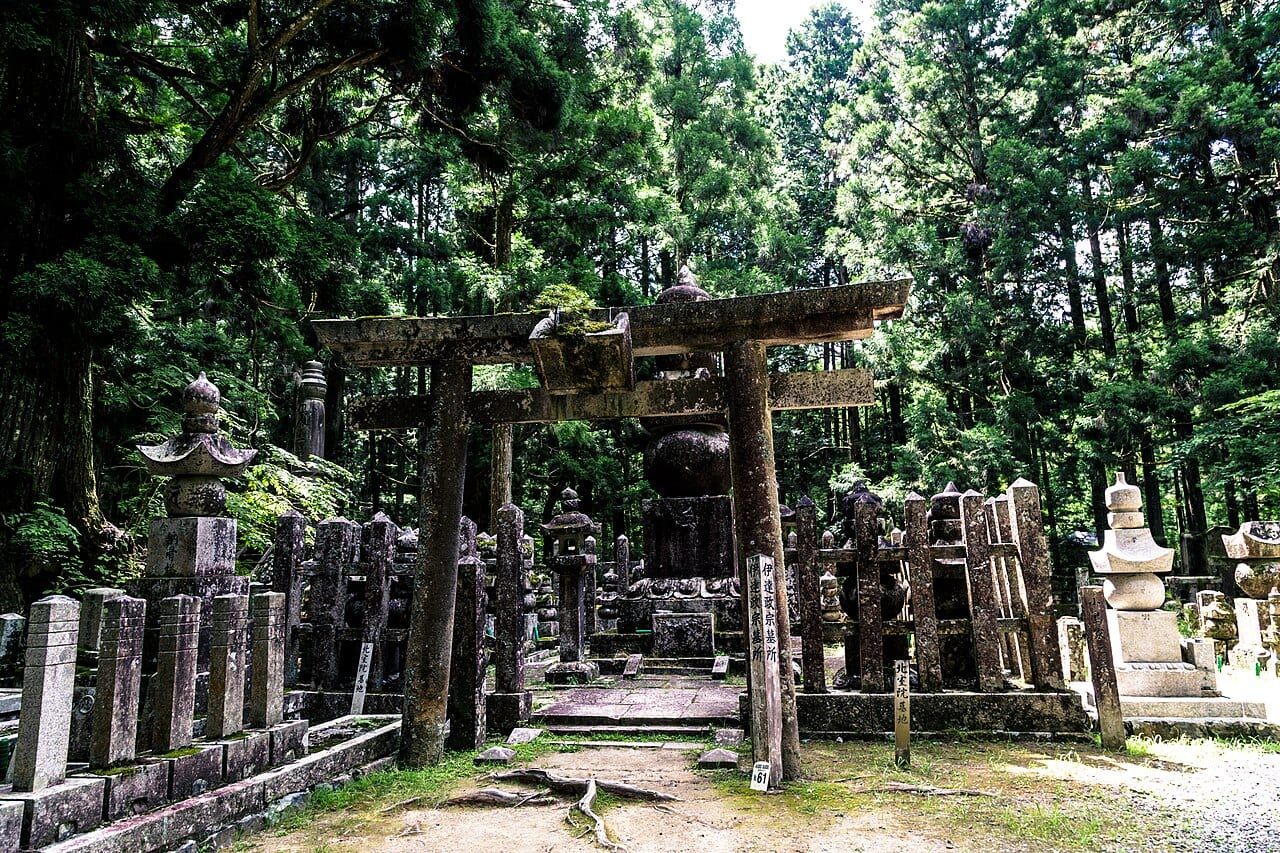
A gorinto is said to symbolize Dainichi Nyorai. In Japan, gorinto have been built as memorials for the dead since the Heian period, a custom said to have begun at Koyasan. Many of Okunoin’s grave markers are gorinto, so you will see this shape again and again along the approach.

Who is buried or remembered at Okunoin?
The imperial family and nobles, founders of other Buddhist schools such as Honen and Shinran, warlords, Edo-period lords, writers and ordinary people rest or are remembered at Okunoin.
Warlords and lords
The warlords include Uesugi Kenshin, Takeda Shingen, Oda Nobunaga, Date Masamune and the Toyotomi family. Oda Nobunaga’s memorial stands just before the mausoleum. Toyotomi Hideyoshi’s stands before Gobyo-bashi on raised ground.
Takeda Shingen and his son Katsuyori have two gorinto, facing Uesugi Kenshin’s vermilion mausoleum across the approach. Kenshin’s mausoleum is an Important Cultural Property.
Gorinto of feudal lords make up the core of Okunoin’s graves. That is largely because Tokugawa Ieyasu made Koyasan his family temple.
Temples with family ties
Temples on the mountain keep family ties to the graves. Shojoshin-in maintains Uesugi Kenshin’s mausoleum in Okunoin. Rengejo-in has tombstones of the Sanada family behind it, and Komyo-in holds the remains of generations of the Hachisuka family.
Company memorials
Okunoin’s company memorials are gravestones shaped like companies’ products or logos, standing along about 200 m of stone path. Companies built them for their late employees, and industry groups built some as well.
Among them you will find:
- a memorial modelled on the rocket of Apollo 11, from ShinMaywa
- a giant cup and saucer, from UCC Ueshima Coffee
- a stone shaped like Yakult
- a Fukusuke doll
The custom is said to go back to Edo-period inns and shops. The oldest memorial by a company is Matsushita Electric’s of 1938, with a newer Panasonic stone beside it.
Rituals for the dead: water, lanterns and memorial services
At Okunoin, the dead are remembered with water poured at the Mizumuke Jizo, lanterns donated to the Torodo, candles on August 13 and memorial services at the temples.
Water at the Mizumuke Jizo
The Mizumuke Jizo, by Gobyo-bashi, is a row of Jizo and other Buddhist statues along the Tama river. Before visiting the mausoleum, people scoop water from the basin with a ladle and pour it gently at the statues’ feet. They do it to pray for ancestors and the dead, and to purify themselves.
Long ago there was no bridge, and pilgrims purified themselves in the river. In the Tamagawa River, which flows through the cemetery, you can also see wooden talismans placed there by the devout.
Lanterns and candles
The Torodo (Lantern Hall), the worship hall before the mausoleum, holds more than 10,000 donated lanterns. The temple association says two of its lamps have been burning for a thousand years: one offered in 1016 by a woman called Oteru, and one offered in 1088 by ex-Emperor Shirakawa.
On August 13, the Candle Festival, people walk up to the Torodo between 6 pm and 9 pm to console the souls of their ancestors; free candles are handed out at Ichi-no-hashi from 7 pm. They light candles along both sides of the 2 km approach from Ichi-no-hashi, and the service at the Torodo starts at 8 pm.
Memorial services and ashes
Temples on the mountain accept memorial services for ancestors and the interment of ashes. Fudo-in offers eitai kuyo, a “permanent memorial.” It suits families who cannot visit or look after a grave: the temple holds memorial services for the remains on their behalf.
Legends along the path
Three legends sit near Naka-no-hashi, the second bridge on the approach: a slope, a well and a gorinto that is said to keep cracking.
- Kakuban Slope: anyone who tumbles down these stone steps is said to die within three years. The present slope has 43 steps to ward off such a death, because 42 can be pronounced shi-ni, “a death,” in Japanese.
- Sugatami-no-ido well: a rumor from the Edo period says that if you cannot see your reflection in it, you will die within three years.
- Akechi Mitsuhide’s gorinto: this small gorinto, before Naka-no-hashi, is said to crack however often it is repaired.
Visiting respectfully, and with a guide
At Gobyo-bashi, the third bridge after Ichi-no-hashi and Naka-no-hashi, visitors straighten their clothes and bow before crossing. Beyond it lies the sacred area of the mausoleum, and visitors bow again at the same place on the way back.
Photos near the mausoleum
The official sources used here do not state photo rules. On GetYourGuide, a DeepExperience Okunoin tour says photography and electronic devices are strictly prohibited beyond Gobyobashi. Another of its tours does not allow flash photography. If photos matter to you, read a tour’s rules before you book.
Guided walks
On GetYourGuide, “Koyasan: Sacred Silence of Okunoin at Dawn and After Dark” is a 1.5-hour guided walk at dawn or at night, from $108 per person. “Koyasan: Must-See Okuno-in Cemetery 2-Hour Guided Tour” lasts 2 hours, from $103 per person.
The first suits you if you want to walk at dawn or after dark. The second suits you if you want more time with a guide. Skip both if you would rather go at your own pace. You can compare Okunoin night tours, and if you need a bed on the mountain, see temple stays in Koyasan.
How to see Okunoin’s graves: which way fits you?
Match your plans to a row below.
| Your situation | Best way | Why |
|---|---|---|
| You want to walk on your own | Walk the approach from Ichi-no-hashi | About 2 km to Kobo Daishi’s mausoleum |
| You want a guide at dawn or after dark | “Sacred Silence of Okunoin” walk on GetYourGuide | 1.5 hours, from $108 per person |
| You want a guide for two hours | “Must-See Okuno-in Cemetery” tour on GetYourGuide | 2 hours, from $103 per person |
| You are on the mountain on August 13 | See the Candle Festival | Candles along the approach, 6 pm to 9 pm; service at 8 pm |
| You want to remember an ancestor | Ask a temple about a memorial service | Temples accept memorial services and the interment of ashes |
| No one in your family can tend a grave | Fudo-in’s eitai kuyo | The temple holds services on the family’s behalf |
How this guide was researched
This page draws on the Koya Tourism Association, the Koyasan Shukubo Association’s English and Japanese sites, the official websites of Rengejo-in, Shojoshin-in and Fudo-in, and tour listings on GetYourGuide. Nine sources were read in all. Facts from a booking partner name that partner in the text.
FAQ
How many graves are in Okunoin?
No exact count is given. The approach of about 2 km is said to be lined with more than 200,000 moss-covered memorial towers and graves.
Why do people want to rest near Kobo Daishi?
Because of the faith that Kukai still lives and keeps saving people. Kukai entered eternal meditation at Okunoin, and that faith has continued for some 1,200 years.
Are there memorials to the war dead at Okunoin?
Yes. The cemetery holds memorials to the spirits of soldiers killed in the Pacific War. A memorial built in 1599 by the Shimazu lords honors the dead of both sides of Hideyoshi’s campaigns in Korea.
What happens to ashes placed with Fudo-in?
Ashes placed with Fudo-in are offered tea daily for a year at the temple. After the next Obon, they are laid in the ossuary beside Kobo Daishi’s mausoleum. Fudo-in says more people make this choice as single-person and childless households grow.
Can you rent an audio guide on Koyasan?
Yes. The temple association rents audio guides at its Chuo and Ichi-no-hashi offices, for 500 yen per unit. Rental hours are 8:30 am to 4:30 pm.
Why does Gobyo-bashi have 36 planks?
Its 36 planks plus the bridge itself make 37. That number stands for the 37 deities of the Diamond Realm.
Sources
- Koya Tourism Association (koya.org)
- Koyasan Shukubo Association (eng-shukubo.net)
- Koyasan Shukubo Association, Japanese site (shukubo.net)
- Temples’ own websites (Rengejo-in, Shojoshin-in)
- Fudo-in official website (fudouin.or.jp)
- GetYourGuide